The Camps Bay field guide
The Camps Bay Light, Salt & Wind Playbook
A window-by-window field guide to shading a Camps Bay home — how the west-facing Atlantic glare, the salt air and the summer south-easter change what belongs on each elevation. Written for this stretch of coast, not lifted from a catalogue.
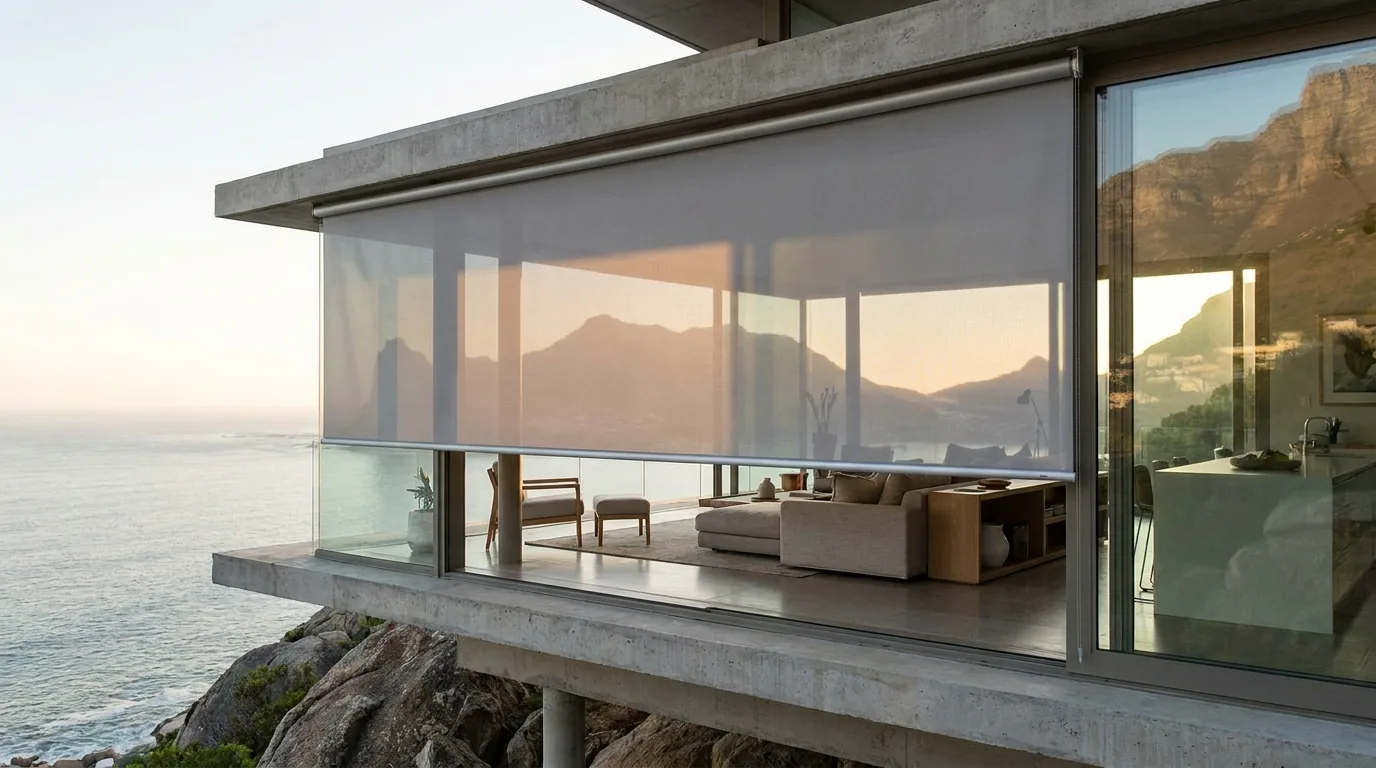
Why Camps Bay is a shading problem of its own
Camps Bay is a suburb built around a view — houses of concrete, glass and steel cascading down the slope below the Twelve Apostles, most of them turned west and north-west to face the Atlantic sunset.
That outlook is the whole point, and also the problem. Newer Camps Bay homes carry far more glass than an ordinary suburb ever has to dress — floor-to-ceiling spans, frameless corners, sliding walls onto the deck — and almost every pane faces the full Atlantic-seaboard weather. One approach across all of it gets most of it wrong, because the north glass, the west glass and the exposed decks each face a different enemy.
Three local forces shape what we specify, and they rarely act alone. First, the light: a west and north-west aspect that takes the low afternoon sun plus the glare bouncing off open water. Second, salt — airborne chloride that eats cheap brackets, chains and cassettes far faster than it would a kilometre inland. Third, wind: the summer south-easter, the “Cape Doctor,” funnelling off the mountain onto anything left open on a terrace. This guide walks the house with all three in mind, elevation by elevation.
A high summer sun, a low winter one, and a hard west afternoon
Camps Bay sits at about 33.95° south. In the southern hemisphere the sun rises in the east, tracks across the northern sky, and sets in the west — so it is your north-facing windows that catch the sun through the year, and your west-facing glass that takes the low, hard late-afternoon light. At the December solstice the noon sun stands nearly overhead here, roughly 79° above the horizon, which means a north window is easy to shade with the eave that is already above it. At the June solstice it drops to about 33° and rakes low across the northern sky all day, pushing deep into north-facing rooms — often the welcome winter warmth you do not want to block.
The elevation that catches Camps Bay out is the west. Through summer the late sun comes in low and level, under any eave, straight onto the glass — then a second helping arrives as glare reflected up off the water. Cape Town’s summer UV runs very high to extreme from roughly October to March, regularly touching the “extreme” band on the WHO index; that is what fades fabric and loads heat through unshaded glazing. So on a west or north-west wall the job is rarely “make it dark” — it is “kill the glare and the heat while keeping the view the window exists for.”
Which side of the house you’re standing on changes the answer
The hard one
The sunset elevation, and the reason most Camps Bay homes are shaped the way they are. Low summer afternoon sun under the eave, plus glare thrown up off the sea. Stopping that heat outside the glass beats absorbing it inside; where the view has to stay, a serious sunscreen earns its place over a plain blockout.
The sun-catcher
High and easy to shade in summer, but the low winter sun pushes right in — so you want to temper glare without losing the warmth you actually want in July. Sunscreen keeps the light and the view; blockout is for the north bedrooms that need to stay dark past an early summer sunrise.
Bright early, calmer later
Morning glare on breakfast rooms and east bedrooms, then an easy afternoon. A sunscreen or a light-filtering cellular takes the edge off the early sun off the water without darkening the room for the rest of the day.
Where the wind decides
The sundowner spot, and the most exposed part of the house. Here the question is less about glare and more about whether an exterior screen or awning will survive the south-easter — which is why wind rating and an auto-retract sensor matter more on the deck than anywhere else.
The recommendations, with both sides of every trade-off
Every choice below is a trade-off, so we’ve put both sides of it. Tap Add on any recommendation to drop it into the ballpark tool and the free-measure list further down — so you carry what fits straight into either path, with no retyping.
West heat: stop it outside the glass
On a hot west or north-west elevation we’d usually intercept the sun before it reaches the pane — external venetians or a roller shutter on the outside of the glass, rather than an interior blockout roller. The reason is physics: an external screen stops the heat outside, while an interior blockout only blocks the light after the glass has absorbed the heat and begun radiating it into the room. On Camps Bay’s big west panes that difference is felt by three in the afternoon.
The honest trade-off the other way: external shading costs more, and on the sea front it must be salt-air rated hardware from day one. If budget or a body-corporate facade rules it out, a high-performance sunscreen roller inside is the next best thing, ideally with a blockout behind it for the evening.
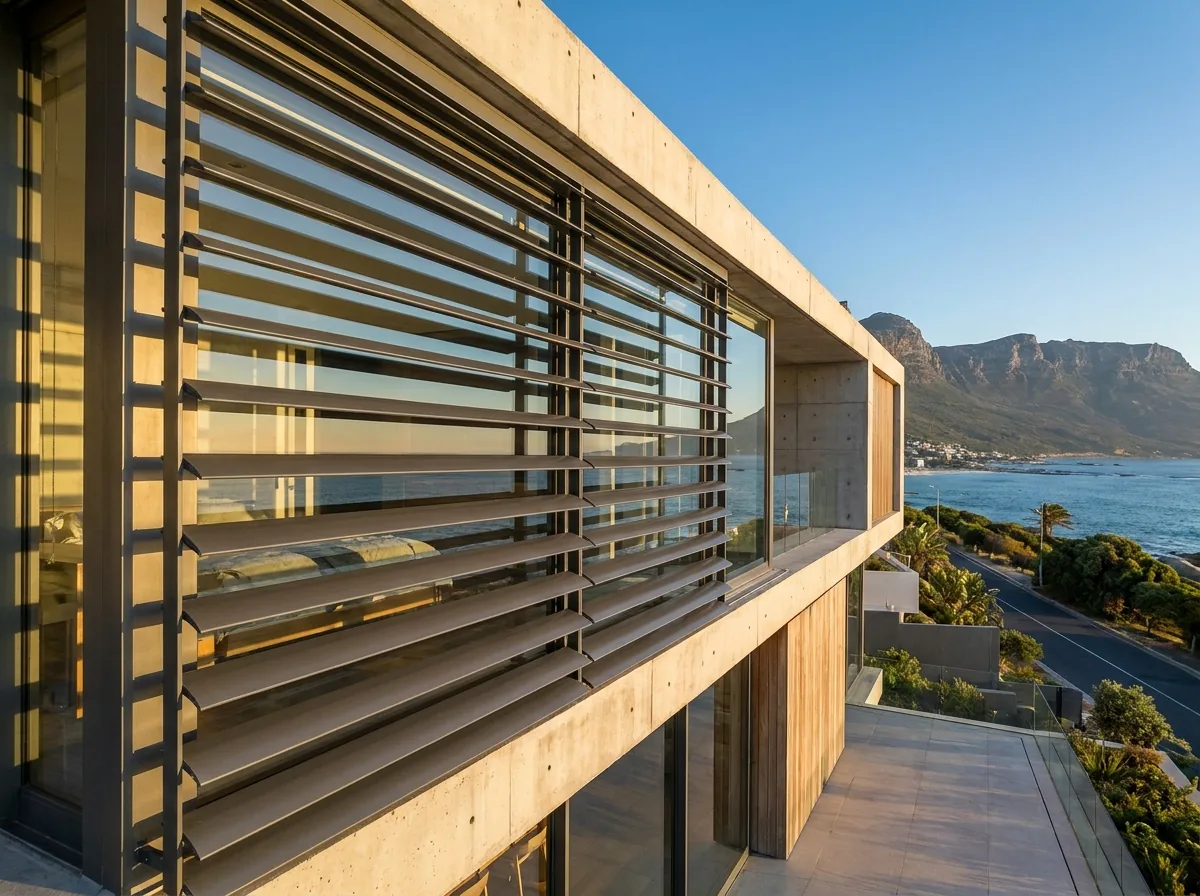
The sea view: a sunscreen roller, not a plain blockout
Most of the glass in a Camps Bay house exists to see the Atlantic, so an opaque blockout across the living-room windows solves glare by throwing away the reason the window is there. A sunscreen mesh cuts glare and UV and keeps the ocean and the Apostles visible as a soft silhouette. Openness is the dial: a 3–5% weave is the usual view-preserving choice on these wide panes — lower openness blocks more heat and glare but shows less through the fabric.
The honest trade-off: a sunscreen is not a privacy blind after dark — once your lights are on and the sea is black, people outside can see in more than you’d like. That is exactly why the day-and-night double roller below exists.
Bedrooms: blockout roller, or the day/night double for a view worth keeping
A west or north bedroom needs to stay dark past a bright summer dawn, and a blockout roller does that cleanly. But where the bedroom also owns an ocean view you would rather not lose by day, a double day/night roller carries a sunscreen and a blockout on one bracket — sheer for the view in daylight, blockout down at night — without two separate blinds fighting over the same window.
The honest trade-off: the double roller is a slightly deeper headbox and a bit more cost than a single blind. If a room only ever needs one of the two, a single blockout roller is the tidier, cheaper spend.
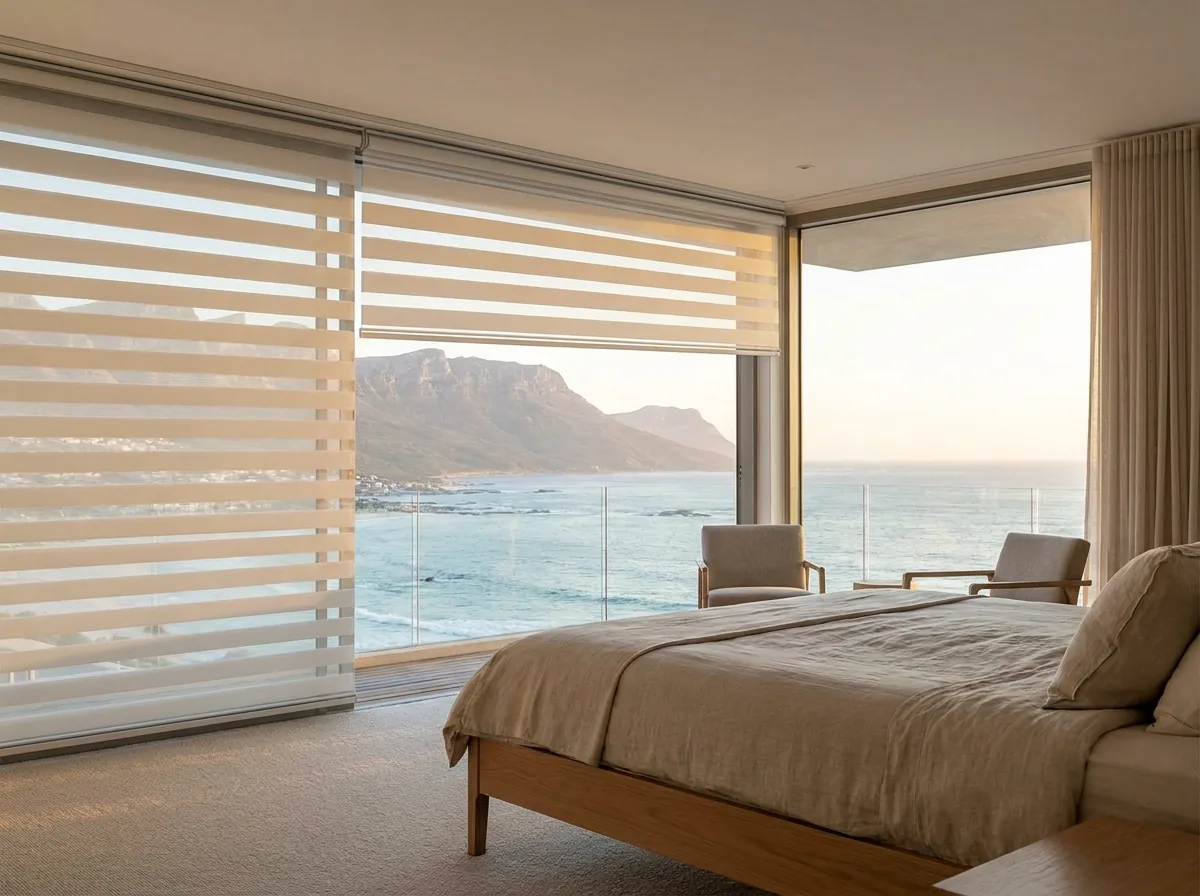
Salt-exposed metal: aluminium venetians, sealed and powder-coated
Where you want to steer the light rather than simply block it — a kitchen, a study, a bathroom facing the water — a slim aluminium venetian lets you tilt the glare off the sea at any hour and shrugs off salt air far better than a raw-timber slat would. This close to the ocean we specify powder-coated aluminium as the baseline, not an upgrade, and isolate dissimilar metals so the fixings don’t corrode where they meet.
The honest trade-off: even marine-grade coatings age faster on the sea front — an occasional fresh-water wipe-down keeps them moving, and we’d rather tell you that now than pretend any coastal hardware is fit-and-forget. Timber venetians look beautiful but are the wrong call in a damp, salty, sea-facing room.
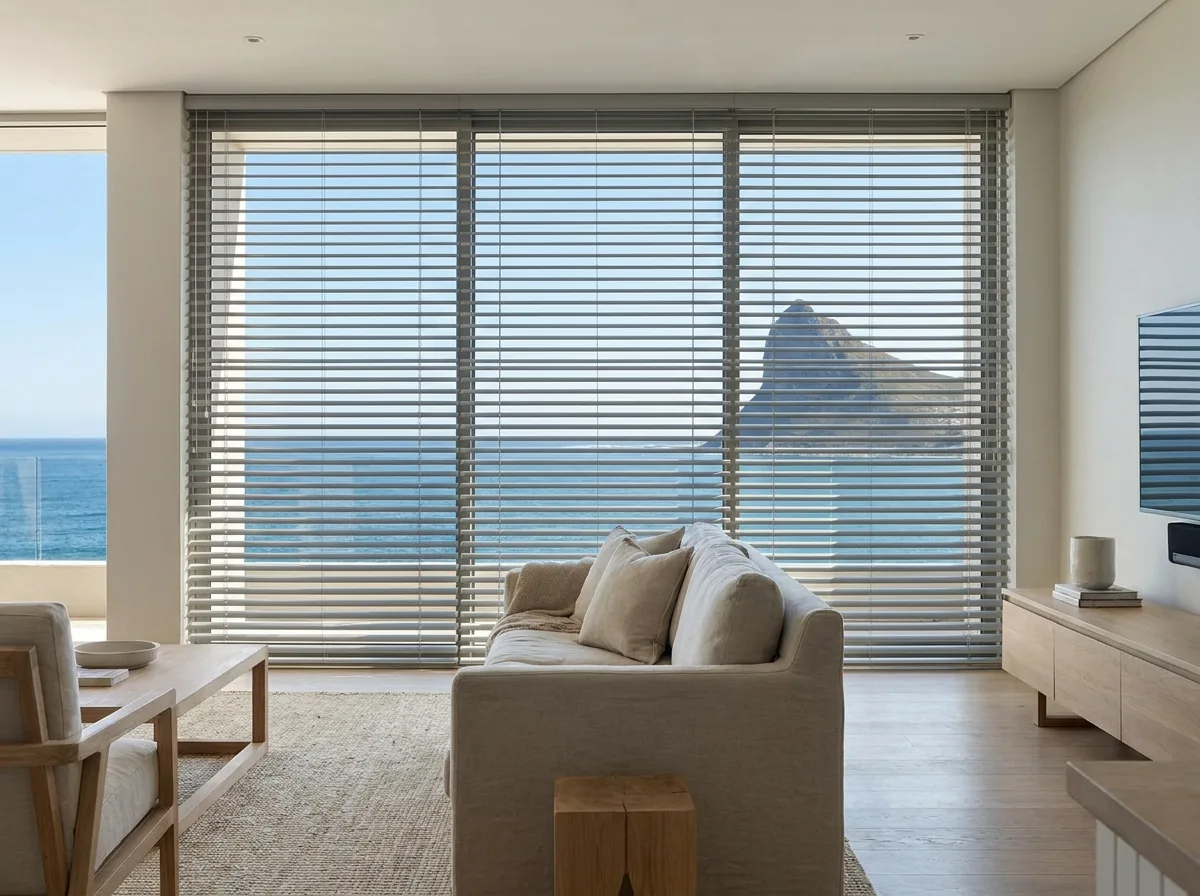
Decks in the south-easter: zip screens and a wind-sensed awning
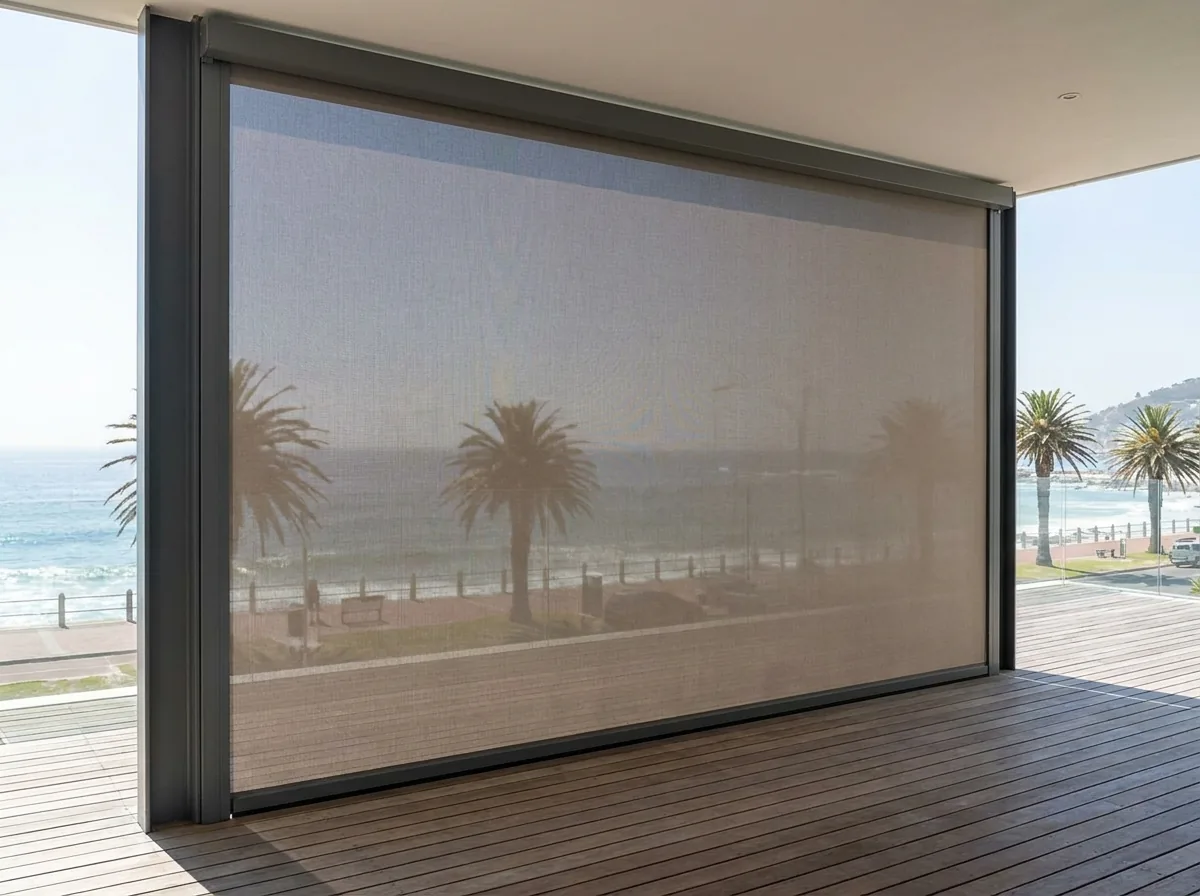
The deck is where the wind, not the sun, sets the spec. A zip screen runs its fabric in fixed side channels so it holds taut instead of flapping, turning an exposed terrace into a usable outdoor room on a windy afternoon; a folding-arm awning gives softer overhead shade for the calmer days. Both belong on a Camps Bay deck, doing slightly different jobs.
The honest trade-off: an awning caught open in a strong south-easter can be destroyed, so on any exposed terrace a genuine wind rating and an automatic wind sensor stop being optional. A zip screen takes more wind than an open awning but is a more fixed, framed look on the elevation — which some facades welcome and some don’t.
Cold or heat-loaded glass: cellular honeycomb as the buffer
A cellular honeycomb blind traps a layer of still air against the pane in its hexagonal cells, which cuts the heat crossing the glass in both directions. On a west window it softens the afternoon heat load; on a cooler south or shaded room it holds warmth in. It is the quiet all-rounder where a room’s issue is temperature more than glare.
The honest trade-off: a cellular is a light-manager and an insulator, not a heat-blocker for a scorching, unshaded west pane — for that, send the heat outside the glass (see the first recommendation). Right room, wrong hero if you point it at raw afternoon sun on its own.
Wide glass walls: motorise them, and let a sensor drive
Camps Bay’s newer builds run to sliding walls and double-volume glazing where a hand-chain four metres down the glass ruins the exact view the architect drew. Motorisation is often the only practical answer at that scale — one button for a whole wall, and battery motors that retrofit without chasing cables into finished plaster. Add a sun sensor and a west wall shades itself as the afternoon turns; add a wind sensor and an exterior awning retracts before the south-easter does it for you.
The honest trade-off: motors and sensors cost more and the power routing has to be planned — on a standard-height, easy-reach window a neat manual roller does the same job for less. Motorisation earns its keep on the big, high and hard-to-reach glass, not on every window.
A note on roller shutters: the roller shutters we fit are shading products — rigid aluminium slats that roll down on the outside of the glass to stop sun, heat and glare before they reach the pane. They are not security-rated shutters; that is a different product, which we can quote on request. Never treat a shading shutter as a way to secure a home.
Shared facades, body corporates and a very steep site
Camps Bay and its neighbours aren’t a heritage-committee suburb, but two practical constraints shape any exterior fitting. The first is the shared facade. Toward the beachfront, and all along Bantry Bay’s cliffs, homes are apartment blocks whose body corporates govern what may hang outside the building. Anything visible from the street — an external venetian, a roller shutter, a zip screen, an awning — we confirm against your scheme’s approved colours and fixings before quoting, and we’re happy to deal directly with a managing agent or trustees.
The second is the ground itself. These houses step down narrow, winding roads on a steep slope, with driveways cut into the terrain and, in Llandudno, a single access road and no shops at all. Where a van can stand and how a tall glass wall is reached safely is a question we settle at the measure, not on installation day. On the newer frameless builds it flips: a concealed head detail for a recessed roller wants planning early, before the ceiling is closed.
What a photo and a floor plan can’t tell us
This guide gets you most of the way to the right product for each elevation. The last stretch only an in-home measure resolves — and on this coast it is the stretch that decides whether a blind still works in five years or rattles loose in one:
- Exact reveal depth on each opening — whether a blind sits inside the frame or has to face-fix above it, which matters most on the frameless corners and sliding walls typical of the newer builds here.
- The fixing substrate behind the plaster — concrete, brick, steel or a bulkhead — which decides the bracket, and whether a heavy motorised unit on a wide glass wall can hang safely.
- How exposed each deck and upper window really is to the south-easter — the difference between a folding-arm awning and a taut zip screen, and whether a wind sensor is essential rather than a nice-to-have on your particular terrace.
- How much salt spray your position actually takes — front-row sea-facing glass wants a higher coating grade and a rinse routine than a unit set back behind others, and we’d rather match the hardware to the exposure than over- or under-spec it.
- Motor power routing on concealed, double-volume and linked installations — where the cable runs, whether it’s a battery or wired motor, and what has to happen before a ceiling or bulkhead is closed.
Ready to price it? Two honest ways to start
Want a ballpark first? Pop your rough sizes into the tool below and we’ll send a budget range by the next working day — no visit, no obligation. Not sure how to measure, or you’d rather it was done properly? Leave the sizes: our consultant measures every window free and you get exact per-window pricing. The free measure is the one we’d point you to — the ballpark is just there if you like a number in front of you first.
Book your free expert measure
The one we’d recommend. A consultant measures every window, checks light, fixings, salt exposure and wind, brings fabric samples, and leaves you with a written, itemised, per-window quote.
We take five or six measure appointments a week across Camps Bay and the Atlantic seaboard, so the diary tends to fill a week or two ahead — booking early just means you get the day you want.
Or get a rough ballpark first
Discreet and non-binding. Add each window, and we’ll send a budget range by the next working day. Not sure of a size? Leave it blank and note the room — or just book the free measure and we’ll do the measuring.
| Room | Width (mm) | Drop (mm) | Fit | Product | Remove |
|---|
Where the local facts come from
The climate, geography and suburb facts in this guide are drawn from the sources below. The summer and winter sun angles are calculated from Camps Bay’s latitude of about 33.95° south and the standard solar declination, so they’re worked out rather than quoted; everything else is cited.
- Camps Bay location and latitude (33.95° S), Atlantic Seaboard aspect: en.wikipedia.org/wiki/Camps_Bay and latitude.to
- Southern-hemisphere sun path (sun in the north; west/east glass takes low summer morning and afternoon sun): harvestingrainwater.com and yourhome.gov.au
- The south-easter “Cape Doctor” — season (late Oct–early Apr, peak Nov–Mar) and strength: en.wikipedia.org/wiki/Cape_Doctor and capetownmagazine.com
- Cape Town summer UV index (very high to extreme, ~Oct–Mar): weatherandradar.co.uk/uv-index/cape-town and ird.fr
- Salt-air / marine corrosion and coastal-grade powder-coating on aluminium hardware: windowanddoor.com and servicelinksa.co.za
- Camps Bay housing stock and contemporary glass architecture facing harsh south-easterly winds: architizer.com and mojostumer.com